Appraisal Changes – Not So Fast!

In September, I wrote about the significant changes coming to the residential appraisal process, with a mandatory implementation date of November 2, 2026.

Well, as with so many things in the real estate industry, there’s been a change to the plan!

On September 30th, Fannie Mae and Freddie Mac announced a temporary policy exception for lenders who weren’t going to be ready to meet the November deadline.

Before we get into what that means, let’s do a quick refresher.

What’s Changing?

The residential appraisal forms that have been used for years are being replaced with a new, more comprehensive reporting system known as the Uniform Appraisal Dataset, or UAD 3.6.

Rather than using separate traditional forms for different property types, appraisers will work with a single adaptable report that changes according to the characteristics of the property being appraised.

The goal is to improve the quality and consistency of appraisal information and make the review process more efficient.

Has the Deadline Been Extended?

Technically, no.

November 2, 2026, remains the official implementation date. Lenders who aren’t ready can request permission to temporarily continue using the old appraisal reporting format.

Here’s how the transition will work:

  • November 2, 2026 – February 28, 2027: Lenders with an approved exception can continue submitting appraisals using either format.
  • March 1 – May 19, 2027: The exception continues, although lenders using the old format will face additional limitations.
  • May 20, 2027: New appraisal submissions must use the new format under Fannie Mae’s announced schedule.
  • June 28, 2027: Fannie Mae will discontinue acceptance of the old appraisal format entirely.

So, while the industry has been given some breathing room, these changes are still coming.

Why Is This Particularly Interesting for the Outer Banks?

Let’s face it. Appraising real estate on the Outer Banks isn’t quite like appraising homes in a subdivision where there are 50 nearly identical properties.

We have homes with very different characteristics, sometimes right next door to one another.

Oceanfront versus oceanside. Soundfront versus soundside. Vacation rental homes versus primary residences. Private pools, elevators, views, beach access, flood zones, and differences in construction quality.

All of these things can impact a property’s market value.

My hope is that a more detailed appraisal reporting system will ultimately help capture some of those nuances. That’s something we’ll have to evaluate as we gain more experience with the new reports.

What Should Buyers and Sellers Do?

If you’re buying or selling a home and the transaction involves financing, it’s worth having a conversation with the lender early in the process.

Find out whether they’ve transitioned to the new appraisal system and whether they’re experiencing any changes in appraisal turnaround times.

For sellers, this is also a good reminder to keep records of improvements, renovations, permits and other relevant property information readily available.

The more accurate information we can provide about a property, the better.

Will these changes ultimately improve the appraisal process? I certainly hope so!

In the meantime, I’ll continue to keep you informed as the industry works through this transition.

The Outer Banks Real Estate Market

What’s Really Happening?

As we approach the end of 2026, I’m hearing more and more people asking what’s going to happen to the real estate market in 2027. Are prices going to come down? Is now a good time to buy? Have I missed my opportunity to sell?

All great questions! Before we start looking into the crystal ball, let’s take a look at what the market is actually doing.

Here are the numbers.

Looking at all residential sales recorded through the Outer Banks MLS from January through October:

2025 2026
Total Sales 1,521 1,544
Median Sold Price $589,500 $575,000
Median Days on Market 41 33

Sellers received an average of 96.4% of their asking price during the first ten months of 2026.

So we have more sales, slightly lower prices, and homes selling in fewer days. What gives?

The Market Is Becoming More Selective

One of the things we have to understand about the Outer Banks is that we are largely a discretionary real estate market. Many of our buyers don’t HAVE to buy a home here. They WANT to buy a home here. There is a significant difference.

When the cost of purchasing and maintaining a second home increases, buyers naturally become more selective about what they’re willing to purchase.

They’re looking more closely at condition, location, rental income, insurance costs and what additional money they’ll need to spend after closing.

The good news is that buyers are still buying!

What Does This Mean for Sellers?

One of the most important things to understand in this market is the difference between having a market problem and having a positioning problem.

When nothing is selling, we have a market problem. When comparable properties are selling and yours isn’t, we have a positioning problem.

If homes are selling in 30 to 45 days and yours has been on the market for several months, it’s time to take a closer look at how your property is positioned against the competition.

Price, condition, presentation, and exposure all play a role.

What Does This Mean for Buyers?

If you’ve been sitting on the sidelines waiting for the perfect time to buy, this may be a good opportunity to start exploring your options.

Depending on the property and location, you may find more opportunity to negotiate than you had a few years ago. That doesn’t mean every seller is desperate or every property is overpriced.

The key is knowing the difference.

Looking Ahead to 2027

After three decades in Outer Banks real estate, I’ve learned that our market doesn’t always follow national trends, and it certainly doesn’t always follow them on the same timeline.

I’ll be watching inventory, buyer activity, interest rates and the ongoing cost of homeownership as we head into the new year.

In the meantime, if you’re curious about what’s happening in your particular neighborhood, or what these numbers mean for your property, I’m always happy to have that conversation.

Real estate is local.
On the Outer Banks, it’s VERY local!

Selling This Fall? A Major Appraisal Change Could Affect Your Closing Timeline

If you’re planning to sell before the end of the year, there’s a change happening behind the scenes of every financed sale that could catch you off guard: the entire residential appraisal system is being overhauled, and the mandatory deadline lands right in the middle of peak closing season. Here’s what’s changing, when it hits, and what it means for your sale.

What’s Actually Changing

Fannie Mae and Freddie Mac are retiring every legacy appraisal form — including the familiar 1004 used for most single-family homes — and replacing them all with a single, dynamic report called the Uniform Residential Appraisal Report, or URAR. Instead of a fixed template, the new report expands or contracts based on your property’s specific characteristics, and it’s submitted digitally as a structured data file rather than a static PDF.

This is the most significant change to residential appraisal reporting in over a decade, and it touches virtually every home sale that involves a mortgage — which means it very likely touches yours.

Key Dates You Should Know

  • Now through November 2, 2026: Lenders and appraisers are transitioning — some are further along than others.
  • August 6, 2026: The system began flagging appraisals still submitted in the old format, though it isn’t rejecting them yet.
  • November 2, 2026: The old format is retired for good. Any new appraisal must use the new report from this date forward.

If your home is under contract this fall, there’s a real chance your appraisal will be completed during this transition — which is exactly why it’s worth understanding now, not after it happens.

Why This Matters to You as a Seller

An appraisal that comes in on time and supports your sale price is one of the last hurdles between contract and closing. A few things are worth keeping in mind as this transition plays out:

  • Possible timeline adjustments: Some lenders and appraisers will still be adjusting to the new report format this fall, which can add a few days to an appraisal that would have moved faster a year ago.
  • More structured, more detailed data: The new report captures property information in a more granular, itemized way. Homes that are well-documented and well-presented are positioned to move through this process more smoothly.
  • Your agent’s readiness matters: An agent who understands the new format can anticipate questions, keep your closing on track, and flag potential issues before they become delays.

What You Can Do Now

You don’t need to become an expert in appraisal standards — that’s what your agent is for. But a few simple steps can help your sale move as smoothly as possible through this transition:

  • Have your home’s key details — recent upgrades, permits, square footage documentation — organized and ready to share.
  • Ask your agent directly how they’re preparing for the transition and what it could mean for your specific timeline.
  • Build a little flexibility into your closing expectations this fall, especially if you’re coordinating a sale with a purchase elsewhere.

The Bottom Line

This appraisal overhaul isn’t a reason to delay selling — it’s a reason to work with someone who’s already ahead of it. With the right preparation and the right team, your sale can move through this transition without missing a step.

If you’re thinking about listing this fall, let’s talk about what this means for your specific timeline before you go to market.

Why Selling Now Makes the Smartest Financial Sense

Every Cycle Tells the Same Story

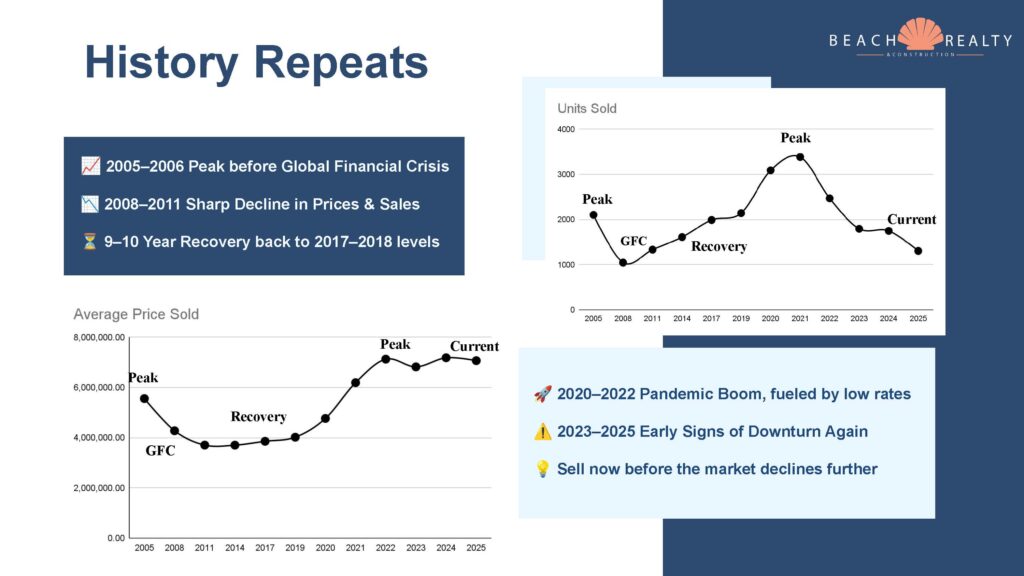
In 2005 and 2006, we hit a major peak before the 2008 financial crisis struck. From 2008 through 2011, prices and sales activity fell sharply — and it took nearly a full decade to recover. Then came another boom from 2020 to 2022, fueled by record-low interest rates and intense buyer demand. Now, as we move through 2023–2025, we’re beginning to see familiar signs: softening demand, rising inventory, and leveling prices.

That pattern should sound familiar — because it’s the start of the next cycle.

The Psychology of the Market

We all remember that subprime mortgages triggered the 2008 crash. What’s happening now is broader — economists call it the “everything bubble.” Once bubbles begin to deflate, it typically takes four to five years to reach the bottom. The reason? Seller denial. Sellers hold out, convinced prices will bounce back, while buyers wait for better deals. In a resort market like ours, where neither side must move, both dig in.

Sellers say, “I’ll just keep it for now.”       Buyers say, “I’ll wait until prices drop.”
And who wins the waiting game? Buyers do — every time.

Key Takeaways

• The last downturn took nearly a decade to recover.
• We’re seeing early signs of another correction.
• Selling before the decline accelerates protects your equity.
• Waiting could mean competing with more sellers at lower prices — and watching your gains fade over
years, not months.

Absorption Rate

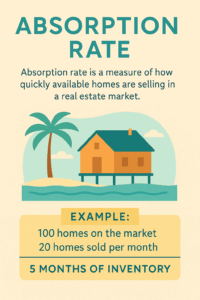
Absorption rate is a key real estate metric that shows how quickly available homes are selling in a specific market.
It’s calculated by taking the number of homes sold and comparing it to the total number of homes currently for sale.

How to use the number:

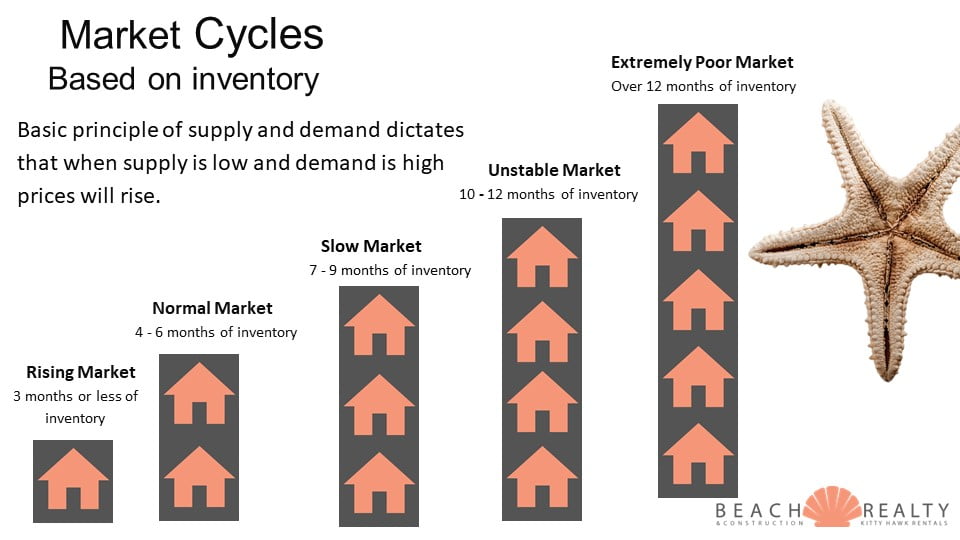
  • 0–3 months → 🔥 Seller’s Market (homes selling quickly)
  • 4–6 months → ⚖️ Balanced Market
  • 7+ months → 🧊 Buyer’s Market (homes sitting longer)

See how each town compares here: 

Corolla Duck S. Shores Kitty Hawk KDH Nags Head
Active –  145 32 18 30 100 62
Sold/Month – 17.8 7.3 7.8 7.1 21.8 14.9
Abspt Rate –
in months
8
months
5
months
2.5
months
4
months
4.7
months
4
months
*NL/Month  37 11 3 9 42 13

(*NL/Month = New listings each month)

We know a market is shifting when the Absorption rate goes over 6 AND the number of new listings each month far exceeds the number selling each month.  We are watching Corolla and Kill Devil Hills closely right now.


July OBX Market Stats

While there isn’t much change to report this month, I predict by October/November there will be more inventory and the beginning of a quantifiable shift in pricing. You know I’ll keep you posted! To see the full effect of the logarithmic path, I’m comparing January 2024 to July 2024.

Jan 2024 Jul 2024
Months of Inventory 4.8 5.9
Active Homes 492 700
% Under Contract 24% 21%
Price Changes/Month 171 232


image of OBX Market Cycles

2024 Second Half of the Year Weird Market Selling Strategy

As we approach the second half of the year, it’s important to notice the little shifts happening along the way.  Remember, real estate markets don’t crash overnight.  It happens slowly at first, then all of a sudden.  We are in the slowly at first phase.

Our market here gets insulated because it’s not a primary market.  Being a discretionary sale and discretionary purchase for the majority of transactions, it provides a lag time from when we start to see primary markets destabilize.

If you are thinking about what to do with your OBX investment home, you need to look big picture.  Consider first and foremost, just because you don’t HAVE to sell, does not automatically mean that keeping the home is in the best financial interest for your family.  Always consult your financial adviser for guidance.

Let’s now take a look at the two options, sell or keep.  Regardless of what you choose, this information will help you set up the best expectations for either choice.

Sell

  • Good news! Prices are still at record highs.  You have not missed the boat.
  • However, pricing strategy must remain fluid. No longer set the price and then 3 months later look at it.  If you want to maximize profit here, you must be the trend setter, not the follower.
  • Inventory is rising – up 29% from this time last year
  • Demand is dropping – down almost 10% from last year, and last year demand dropped 50% from 2022
  • Price reductions are increasing – in May 368 new listings came on and 287 listings had a price reduction
  • Must be negotiable – 66% of properties sold are below asking price.
  • Affordability is still the number one concern for buyers

If you employ a listing strategy with this in mind, you will maximize your return and get the home sold in a reasonable amount of time.

Keep

  • Remember how these cycles have worked over the years.
    • Boom 1985/86 – fell apart early 90’s – stagnant until 2000.
    • Boom again 2004/05 – fell apart 2008/09 stagnant until 2019/20.
    • Boom 2021/22 – 2023 activity dropped by half, pricing is just starting to crack with price reductions and under asking price sales.
    • If the pattern continues it could be stagnant again until 2035 or longer.
  • Rising Insurance as well as other increasing vendor costs.
    • be prepared for at least a 14% increase in dwelling policies and unknown yet for homeowners.
    • Service providers are increasing costs: lawn care, pool/hot tub maintenance, linens, etc
  • Return to pre-pandemic rental income.
    • It starts with lower vacancy rates. 2024 is already seeing only 90% booking.
    • Next will be set lower rates – discounts are already happening.
    • If you stay, the cost to own will go up, with income to support going down.
  • Prepare for capital improvements.
    • Tightening insurance underwriting regulations are requiring updates to stay insured. Roof, water heater, etc
    • Continued lack of demand for homes that have not been updated. Especially as inventory increases, you’ll need to have prime condition and updating to be chosen.
    • Reality of a major storm this year or next. Let’s face it, no one likes to say it, but we haven’t had a hurricane since 2018.  Generally, we see a 6 to 9 year pattern.

If you do decide to keep the home through the next cycle, let’s at least put together a plan to get your home updated and where to best spend the money.  I also have a list of trusted vendors who can help you get things done.

Now that you have the big picture, let me know if I can be of any help as we navigate this next market shift.

First Quarter 2024 Comparison to First Quarter 2023

OBX Real Estate Market - Crystal Ball and upward graphWhat a difference a year makes!  Long story short, there are some BIG moves that are happening.  I’ve talked before about algorithmic decay.  This chart here is exactly that!  Little, by little, by little, then bang.  That’s how markets change.  Tale as old as time, song as old as rhyme, it’s almost as good as a crystal ball.
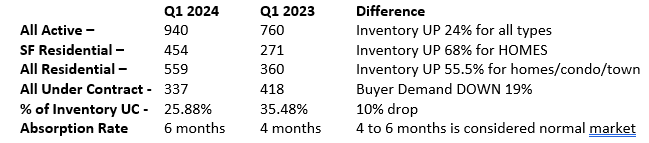
Anyone saying the real estate market on the Outer Banks is not changing is just not paying attention.

But, look here, and you decide:

Image of the differences between 2023 and 2024 in the OBX Real Estate Market

We are on the cusp of a price shift potentially starting this fall.  Here are the facts about our market:

  • Insurance costs are rising and coverage dropping
  • Interest rates are not changing any time soon
  • Rental income is back to pre-pandemic levels

If you are on the fence about selling your home, your window is closing before we start to see quantifiable price shifts.  Call me today to discuss the best strategy for selling in today’s changing market.

How NOT to set the listing price of your home.

151 Salt House Road, CorollaA lot of agents will do presentations on how they came up with a price for your home. It is a task that does require some skill. The challenge of course is getting the seller to agree to the pricing suggestions.

Many sellers come into the meeting with a general idea of what they want for the home, which is helpful. However, here are a few ideas on what NOT to do when you decide to sell your Outer Banks home in today’s market.

  • Tax Assessment – Don’t confuse your county tax assessment with market value. Your tax assessment is for the purpose of assessing a tax amount to you for the purpose of revenue to the county. It doesn’t in any way suggest that’s what a buyer is willing to pay or a seller is willing to sell for. Most importantly the assessment on your home right now is 4 years old! On the Outer Banks they only re-assess every 8 years. Because it’s 4 years old, it also doesn’t take into consideration any improvements that have been done since the last assessment.
  • Old Appraisal – Appraisals are only good for the day they are written. What? Yes, that’s correct. Considering that anything and everything could change tomorrow, an appraisal can only be valid for one day. If you have a year-old appraisal and want to base your price on some reflection of that, you might find yourself the highest bidder of your home. I mean I was a size 8 years ago, but that’s not exactly going in my dating profile for today!
  • Old Sales in the area – All agents have heard it… “Well, my neighbor sold last year for $30,000 more.” Markets never stay the same. It’s an ever-changing environment, which is why consulting with a good agent who studies home prices every day is the best way to get closest to current market value.
  • Recent Improvements – We’ve also all heard… “Well I have a new roof, HVAC and carpet. I want to ask $extra to cover those costs.” The fact that you’ve done these “maintenance” items is great. It shows you’ve taken care of the home. The problem is all houses need a roof, HVAC and carpet. In this market, that can make your home more saleable, not necessarily more valuable. Buyers expect the basic components to be in good condition already. What you can ask more for are upgrades. Changing vinyl to tile or carpet to hard wood, or laminate to granite are all upgrades.
  • Basing the price on your needs – We would all love to get the seller the most money possible. That’s part of our job. However, we can only sell the home for the true market value. Just because you NEED to get $50,000 at closing doesn’t mean it’s going to happen. You have to consider all the current factors in your marketplace and if those point to a lower price, you needing that money will not cause a buyer to pay it if the value isn’t there. You may need to adjust your plans based on what’s realistically going to come out of the sale of your home. These are hard conversations, but a good agent will not be afraid to spell out the truth.
  • Stuck on a previous market value –The last few years have been monumental. It was a fast- rising market and prices skyrocketed. Now we are in a more “normal” market. Prices aren’t rising or falling at a tangible rate just yet. Mostly because inventory is still too low. However, don’t get complacent. Markets ALWAYS cycle. What goes up, must come down. I predict this fall pricing will look differently than it does right now. So, pay attention to CURRENT trends and not what happened the last year or two.
  • Focus only on Price – So often I hear, “I don’t have to sell, I’ll just wait if I have to sell at that price.” Selling a home is based on a LOT of decisions, not just the price for it. No one wakes up and turns to their spouse and says “Honey, the house is worth $X, we have to sell it.” Selling is based upon life changes, new needs, maintenance costs, jobs, marriages and so many more things that are related to the way we live our lives. It’s sometimes concerning when I see a seller refuse to sell based solely on the price. That means they are putting that dollar value above the benefits selling the home can bring to the family. Don’t let the emotional response to the price create a “wish I would have” moment.

Now that we’ve covered what NOT to do, if you need help pricing your Outer Banks home for a prime spot in our market today, certainly let me know how I can assist you!

July Market Update

Happy 4th of July on the Outer BanksMid-year is upon us and not much has changed since the last report.  I did notice an interesting trend regarding CASH in our marketplace.  Here’s the deal.  There have been 136 home sales in Duck and Corolla since January.

Of those 136 home sales:

  • 32 Cash
  • 13 Jumbo Loans
  • 91 Conventional Loans

A conventional loan amount is $726,200.  With the typical 20% down, that means a purchase price of around $875,000.

  • Only 53 of the 136 homes sold were under $900,000
  • 83 homes sold over $900,000 up to $6,300,000
  • 13 were jumbo loans
  • 22 were cash
  • The average price is $1,251,000
  • The median sales price is $992,500

A jumbo loan amount is anything over the $726,200.  There were only 13 of those reported.  There were 48 Conventional loans in the $900,000 and up price range.  This means that 48 buyers out of 83 brought enough cash to the table to get their mortgage at or under $726,200.

To paint a clear picture – 32 cash buyers, 48 mostly cash buyers.  That’s 80 buyers (60%) who brought a ton of cash to the closing table to buy a home on the Outer Banks.  Including the highest sale of the year so far – $6,300,000 ALL CASH!!!!  This just seems amazing to me. (Here’s a link Click Here to View Listings to that home if you want to see what $6.3M gets you)

This is a clear indication that buyers have no problem parking cash in a beach home right now.  I mean, why not?  Let’s look at the 3 main reasons this could be a good idea.

  1. Rental income – If you choose to rent, the income will at the very least cover your mortgage. That means, future equity you reap, all paid by SOMEONE ELSE.
  2. Bank Failures – With banks failing across the country, and the Dodd-Frank Bill legalizing, if not mandating, “bail-ins” a lot of people don’t feel safe keeping their cash susceptible. Rather, they are investing in a tangible asset, and one they can enjoy themselves and have others pay for!
  3. Inflationary Fiat Dollar – Let’s get real, the price of real estate will NEVER go to zero. As inflation spikes even more and more out of control, the dollar is tumbling closer and closer to zero.  It seems buyers are hedging their bets on the tangible asset of real estate versus the tumbling value of the dollar.

We haven’t even begun to see the effects of the commercial real estate crisis looming.  This is widely affecting regional banks who are holding the notes on these buildings that are sitting empty in record numbers across major cities.

Don’t get me wrong, my message is not of doom and gloom.  What’s going to happen is going to happen.  My point is, what is your best move?

If you are considering selling, there are cash buyers waiting for your home.  We do have investment vehicles where you can put your money and AVOID capital gains tax in the meantime.  Contact me for more information.

If you are thinking about buying, get off the fence and don’t let the interest rates deter you.  You won’t have much competition buying right now and there are some great opportunities out there!